
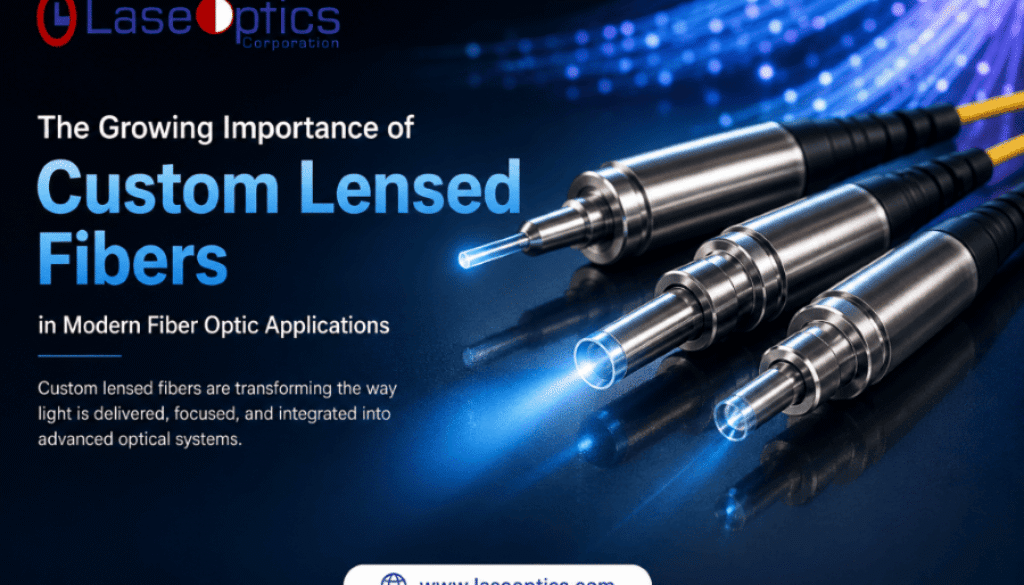
The Growing Importance of Custom Lensed Fibers in Modern Fiber Optic Applications
Out there, where light meets precision, things are shifting fast. Photonics pushes forward, telecom follows close behind, while medical tech and lasers reshape what’s possible. With them grows a quiet need – parts that handle light in very particular ways. Lensed fibers, shaped just right, step into this space without fuss. Efficiency climbs when such pieces take their place. Signals move cleaner through the line. Systems behave better under strain. Performance shifts upward, almost unnoticed.
When companies chase new ideas, they need light-based tools built exactly right. Not just strong but steady too – no shaky signals allowed. These tailored glass threads answer demands across fields like health tech or signal networks. Picture tiny beams meeting exact spots without error. Even laser setups depend on such fine-tuned parts. Science labs use them where detail matters most.
What Are Custom Lensed Fibers?
Lensed fibers carry light through tiny pathways, their ends carefully shaped for directing beams. Not like regular ones, these tweak how light moves when jumping into gadgets. Shaped tips help gather or straighten the glow instead of letting it spread. Moving signals becomes more efficient thanks to their unique endings. Precision at the tip changes how well light connects across systems.
Engineered fibers come in different setups, such as these. Each version shaped for specific needs instead of one-size-fits-all designs. Variations appear across form and function. Some built narrow, others wide. Made to meet distinct tasks through design differences. Custom shapes emerge depending on purpose
- Conical Lensed Fibers
- Ball Lensed Fibers
- Spherical Lensed Fibers
- Angled Lensed Fibers
- Wedge-Chisel Lensed Fibers
- Perpendicular Lensed Fibers
- Increasing coupling efficiency
- Reducing insertion loss
- Improving beam quality
- Enhancing optical alignment
- Supporting compact optical packaging
- Maximizing laser power transmission
- Improved signal quality
- Faster data transmission
- Reduced optical losses
- Better network reliability
- Endoscopy systems
- Optical spectroscopy
- Medical imaging devices
- Laser surgery equipment
- Biosensors
- Photodynamic therapy
- High-power laser systems
- Semiconductor lasers
- VCSEL devices
- Optical amplifiers
- Pump modules
- Optical sensing
- Quantum optics
- Material analysis
- Spectroscopy
- Chemical detection
- Academic research projects
- Enhanced optical confinement
- Improved light manipulation
- Increased sensor sensitivity
- Better coupling performance
- Artificial Intelligence-enabled optical networks
- Advanced biomedical diagnostics
- High-speed data communication
- Quantum communication systems
- Autonomous vehicle sensing technologies
- Defense and aerospace photonics